 Taskriz
Your Contact Form Is Costing You Customers
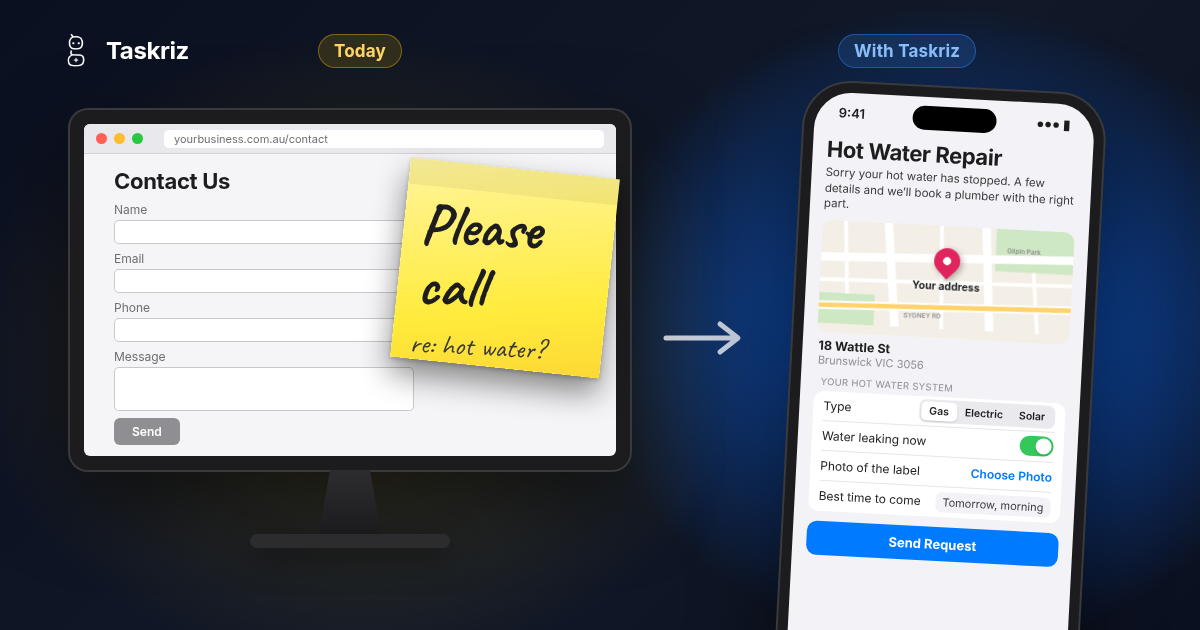
Almost every business website has one. Name, Email, Phone, Message, Send. It looks like customer service. In practice it is a sticky note on your monitor that says “Please call”, and the real work only starts when someone gets around to it.
An electronic sticky note
Look at what a contact form actually collects: a name, an email address, a phone number and a box called Message. Whatever the customer needs, a hot water system that has stopped working, a quote for a new kitchen or a skip bin for Saturday, it all goes into the same four boxes.
That isn’t a request. It’s a reminder to get back to someone. The form has done nothing a sticky note couldn’t do, except arrive by email instead of on the edge of your screen.
Then the tag begins
You call. They don’t answer. You leave a message. They call back when you can’t get to the phone. You send an email with the questions the form never asked: where are you, what kind of system is it, how old is it, is water leaking now, when can someone be home? Two days later a reply arrives with half of the answers.
Meanwhile, your customer filled in three other contact forms. They aren’t loyal to you yet. They’re loyal to whoever gets back to them first with a time, and every round of email and phone tag hands that business another chance to win.
It’s what the form doesn’t ask that matters
A contact form is generic by design: one form for every customer and every question. So it can’t ask the things that make a difference to the follow up conversation.
For a plumber, that’s the address, gas or electric, the brand and age of the system, whether there is water on the floor, a photo of the label and when someone can let you in. Without those, the first call is spent gathering facts, and you may still turn up without the right part and have to come back.
You already know the questions. You ask them on every job. The form just never asks them, so you do, one phone call at a time.
A request, not a message
Taskriz Website Requests replaces the contact form with a request box. The visitor says what they need in their own words, “my hot water has stopped working”, and Taskriz responds with the right form for that query, in your business’s words: the address, the type of system, a photo, the best time to come.
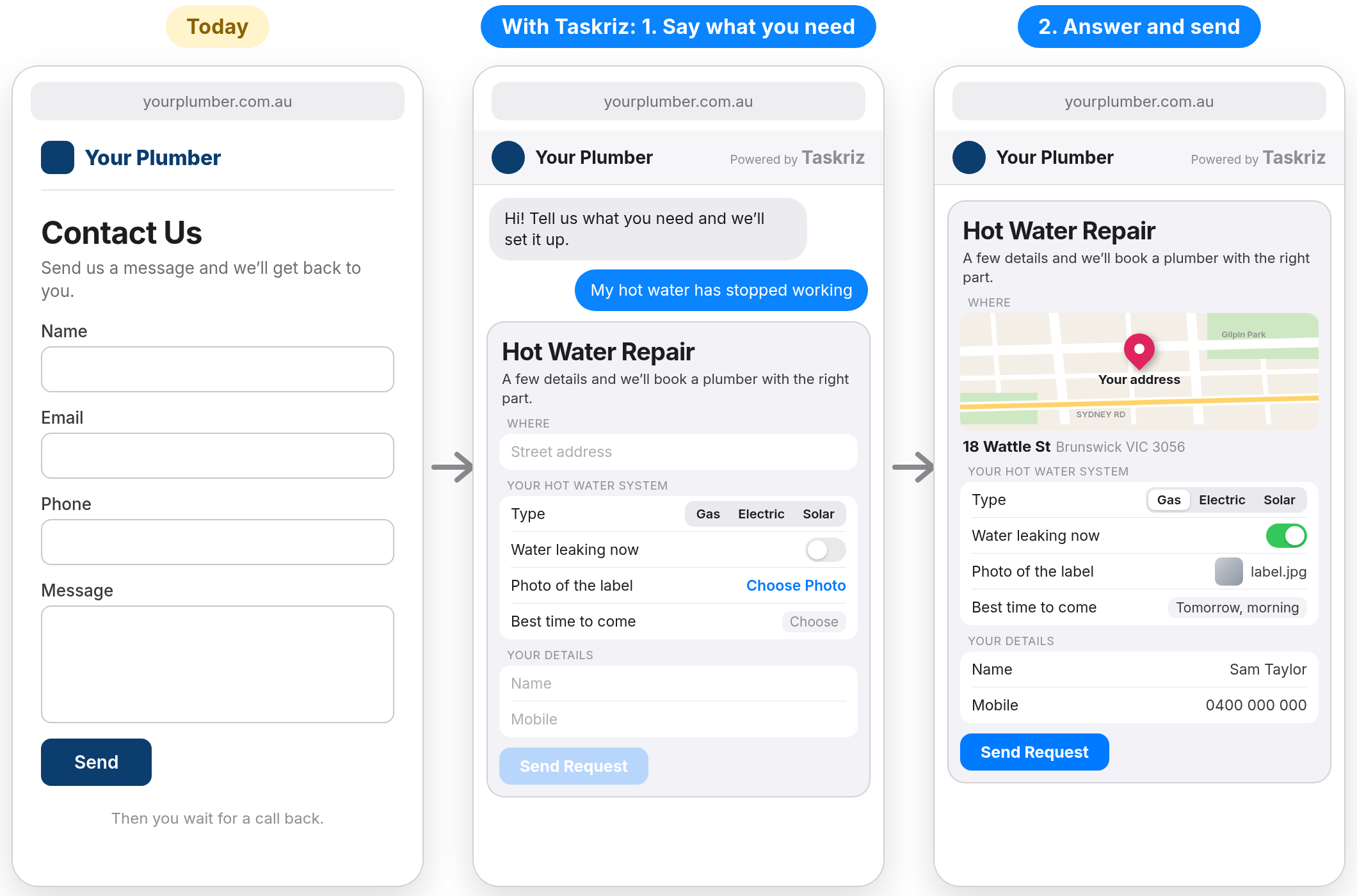
A different query gets a different form. A blocked drain asks different questions to a bathroom renovation, and a bathroom renovation asks different questions to a leaking tap. Any query, the right questions, the first time.
It is not a chatbot. Nobody types back and forth with a bot that pretends to be a person. The visitor gets one clear screen made for what they asked, fills it in and sends it.
Everything you need, in the first instance
What arrives is a complete request: what they asked for in their own words, their contact details, every answer and any photos they added. It lands in your Taskriz inbox, and can be sent to an email address you choose as well, where replying goes straight to the customer.
So the first conversation is a booking, not an interview. You know where you’re going, what you’re fixing and what to bring. Your customer knows you were listening, because you asked the right questions before they had to explain anything twice.
It doesn’t have to stop at the inbox
Because the request is complete and every answer has its place, instead of being lost in a paragraph of free text, it could just as easily become a quote or an order for your services, with no one handling it at all. The hot water repair becomes a job in your job system with the address and the time. A skip bin request becomes an order for the right bin, at the right address, on the right day.
Most of Taskriz you can set up yourself: create your Agent, paste the snippet into your website and you’re taking requests. When you want those requests to flow straight into your quoting, ordering or job system, Appeggio, the team behind Taskriz, will help you get going. See Solutions.
Look at your own contact form
Open your website and look at the form. What does it ask? Now think about what you always have to call back and ask. Every one of those questions is a round of phone tag your customer has to play before they become your customer.
Some of them will wait. Some of them won’t.