 Taskriz
The Application Is Dead, Long Live the Application
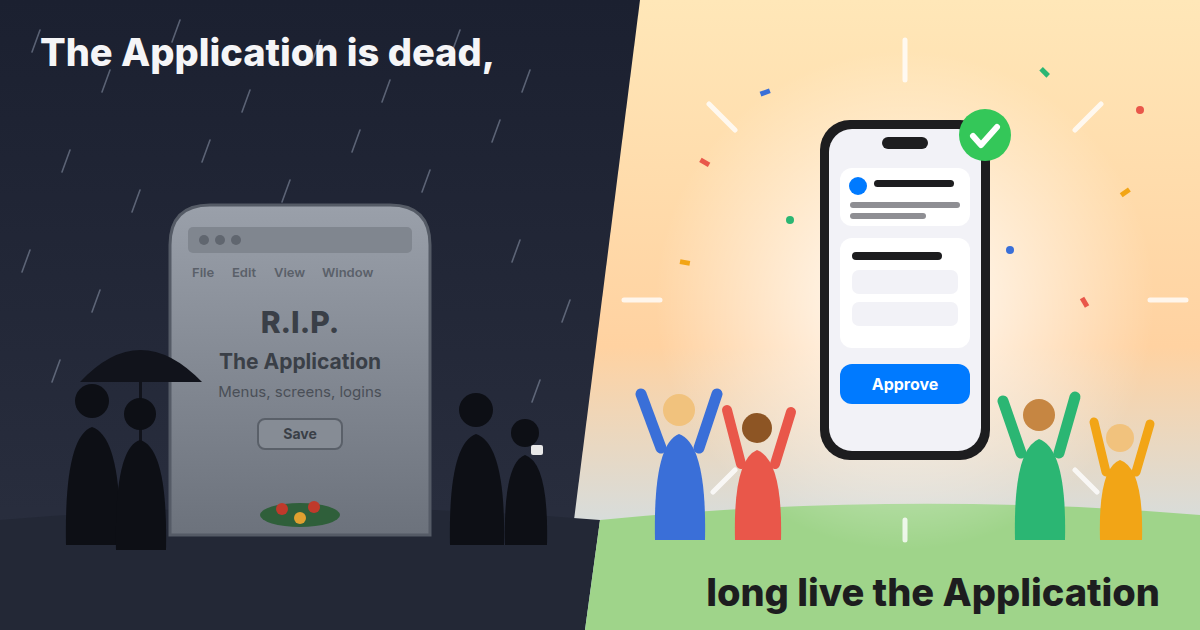
For 40 years the application has been the centre of everything. You open it, sign in, find the right screen and do your task. Taskriz is betting that era is ending, and that what replaces it is better.
AI builds the application now
AI and AI Agents now write applications, front end and back end, faster than any team I’ve worked with. If the screens and the server behind them can be produced on demand, building and maintaining that code is no longer where the value is.
That’s our bet. Developing applications and their back ends, the way we have for decades, is dead.
A new channel appeared
At the same time, people found a new place to get things done. They ask Claude or ChatGPT. An AI chat is now a channel, just as the web and mobile were before it, and every service has to take it into account.
New frameworks and protocols have appeared to cater for it: A2UI, GenUI and MCP Apps. Each lets an AI show people an interface instead of a wall of text. We’ve written about why A2UI is a step backwards, and we’ve put Taskriz side by side with these approaches in our comparisons.
Still thinking in source code
These approaches are a step, but they still feel like source code. The screens are written ahead of time, the components are fixed, and the application decides what happens next. The code may be generated by AI, but it’s still hard coded.
They also assume you’re already inside an application. A2UI and GenUI draw inside the app you’re using, and MCP Apps, to a lesser degree, inside the AI chat you have open.
Taskriz looks further ahead. It uses the interaction itself, whether a customer started it or an AI Agent’s workflow did, to generate the next logical step. The next screen is made for that request, from what has happened so far. That’s more relevant and more flexible than any screen written in advance.
If you believe in AI, let it do what it is best at, and put your effort into the service people need. Call it service as a software: in April 2024 Foundation Capital named the shift “from software as a service to service as software”.
Taskriz comes to you
Taskriz doesn’t assume you’re in an application at all. When something needs you, it tells you, with a notification, an email or a text message. Then it takes you straight to the interface for that one task: on the web, or in our iPhone and Android apps, which are coming to the App Store and Google Play.
It works the other way too. You can start a request yourself, from the things an Agent offers to do. And a business can put Taskriz on its own website, so a visitor’s question becomes the right form on the spot.
The freedom we’ve all dreamed of
Here’s the future we’re betting on. People stop going to a single application and navigating to a screen to do a task. They ask for an outcome, right where they’re most comfortable asking, and they answer requests the same way. It’s a freedom we have all dreamed of.
The application is dead. Long live the application: the one that comes to you, made for the moment you need it.
“The best way to predict the future is to invent it.”
That’s what we’re building.